
Few suburbs show their building history the way Grapevine does. The historic district near Main Street holds cottages that predate the lake, mid-century subdivisions spread outward from there, and newer construction fills in near the lake and highways. Walk a few blocks and you can cross three plumbing generations.
That variety is the whole story for leak detection here. Each era of pipe fails differently, shows different symptoms, and needs a different testing approach. A company that treats every home the same will miss things in Grapevine. We start by reading the house: its age, its materials, and the failure patterns that go with them.
What leaks does each home era bring?
In the oldest homes, galvanized steel supply lines are the usual suspect. The pipe corrodes from the inside, narrowing until pressure drops and pinholes open. Symptoms arrive gradually: weakening pressure, discolored water after taps sit unused, and damp spots where pinholes weep inside walls.
Homes from the 1970s through the 1990s mostly run on copper. Copper resists corrosion well but develops pinhole leaks, often in hot water lines first. These leaks are small and precise: hard to find by eye, ideal for acoustic locating.
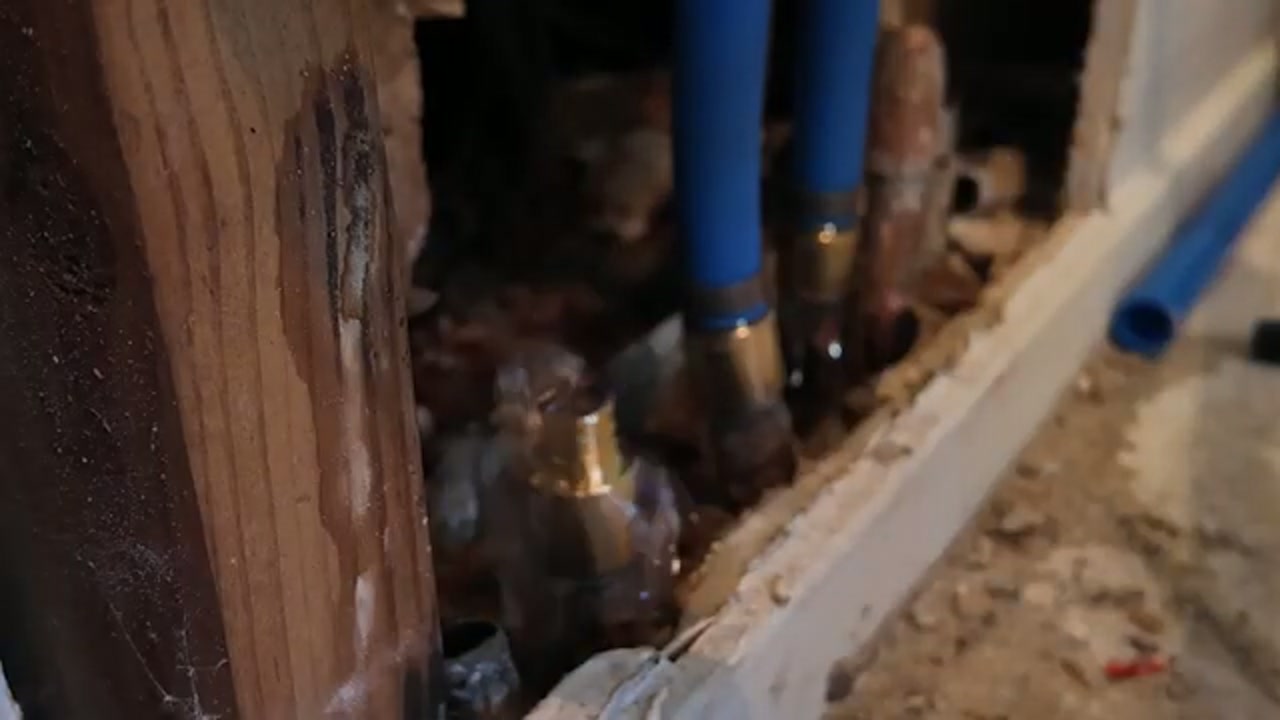
Newer construction uses PEX, a flexible tubing that does not corrode or develop pinholes. When PEX systems leak, the issue is usually a fitting, a manifold connection, or tubing nicked during installation. Those are installation defects, and they can show up in a young home.
Knowing which generation you have tells us where to listen first, so we spend our time on the failure modes your home actually has.
How do you find leaks behind old plaster and layered walls?
Carefully, and without opening anything until we must. Older Grapevine homes often have plaster, layered paint, or paneling over original walls, and owners understandably want minimal disturbance.
Thermal imaging reads temperature differences through wall surfaces. Acoustic listening picks up the hiss of a pressurized leak through the wall. Moisture meters confirm without cutting. We open a wall only at the confirmed point, and only when a repair is going ahead. The goal is one small opening, not exploratory demolition.
The full range of Grapevine leak work
Water service lines deserve attention in the older neighborhoods, where the meter-to-house run may be original. Our water line leak detection finds breaks along those aging runs without digging up the whole path.
Sewer laterals in the historic areas are often the oldest pipes on the property. Clay and cast iron with root intrusion or settled joints show up as slow drains and recurring backups. A camera inspection with sewer line leak locating maps the problem from the cleanout outward.
Slab leaks still appear in the mid-century and later homes built on slabs. Warm floors, phantom water sounds, and climbing bills are the markers, and acoustic tracing finds the break first.
Grapevine's Main Street corridor adds another dimension. Restaurants, shops, and offices cannot shut down for exploratory work, so commercial leak detection is built around off-hours scheduling and precise locating.
Why local experience matters with mixed-era housing
We are based in Flower Mound, minutes from Grapevine, and mixed-era housing is our normal working environment. Reading a home's age from its fixtures and knowing which subdivisions kept galvanized longest changes the testing plan. We answer calls 24/7, and every visit ends with written findings and an upfront quote.
We also serve Coppell and Southlake regularly.